The Complete In-Depth Reference
Psychology, anatomy, real-world examples, entry & exit rules, and common mistakes — for all 19 essential patterns.
Foundation
Every pattern is built on four numbers. Understand these and the rest becomes obvious.
The Four Price Points
The Golden Rules
Quick Reference
All 19 patterns at a glance. Bookmark this table for quick reference during analysis.
| # | Pattern | Candles | Direction | Forms At | Reliability | Confirmation Needed? |
|---|---|---|---|---|---|---|
| 01 | Doji | 1 | Neutral | Any trend | Medium | Always — wait for next candle |
| 02 | Hammer | 1 | Bullish | Bottom of downtrend | High | Yes — next candle above high |
| 03 | Inverted Hammer | 1 | Bullish | Bottom of downtrend | Medium | Essential — requires strong bullish confirmation |
| 04 | Hanging Man | 1 | Bearish | Top of uptrend | Medium | Yes — next candle below close |
| 05 | Shooting Star | 1 | Bearish | Top of uptrend | High | Yes — next candle below low |
| 06 | Spinning Top | 1 | Neutral | Any trend | Low | Always — breakout above/below wicks |
| 07 | Marubozu | 1 | Bull | Breakouts, trend moves | High | Not always — strong on its own |
| 08 | Pin Bar | 1 | Bull/ | Key S/R levels | High | Optional but improves reliability |
| 09 | Bullish Engulfing | 2 | Bullish | Bottom of downtrend | High | Pattern is own confirmation |
| 10 | Bearish Engulfing | 2 | Bearish | Top of uptrend | High | Pattern is own confirmation |
| 11 | Piercing Line | 2 | Bullish | Bottom of downtrend | Medium | Yes — third candle confirms |
| 12 | Dark Cloud Cover | 2 | Bearish | Top of uptrend | Medium | Yes — third candle confirms |
| 13 | Harami | 2 | Neutral | Any trend | Medium | Always — wait for Day 3 |
| 14 | Inside Bar | 2 | Both | Any — after strong move | Medium | Yes — trade the breakout only |
| 15 | Outside Bar | 2 | Both | Any — key levels | High | Depends on closing direction |
| 16 | Morning Star | 3 | Bullish | Bottom of downtrend | Very High | Day 3 is the confirmation |
| 17 | Evening Star | 3 | Bearish | Top of uptrend | Very High | Day 3 is the confirmation |
| 18 | Three White Soldiers | 3 | Bullish | Bottom of downtrend | Very High | Day 3 close = full confirmation |
| 19 | Three Black Crows | 3 | Bearish | Top of uptrend | Very High | Day 3 close = full confirmation |
1-Candle Patterns
One candle — one story. These patterns speak volumes about what happened in a single session and hint at what comes next.
"The market is paralyzed. Nobody won. A big decision is coming — and soon."
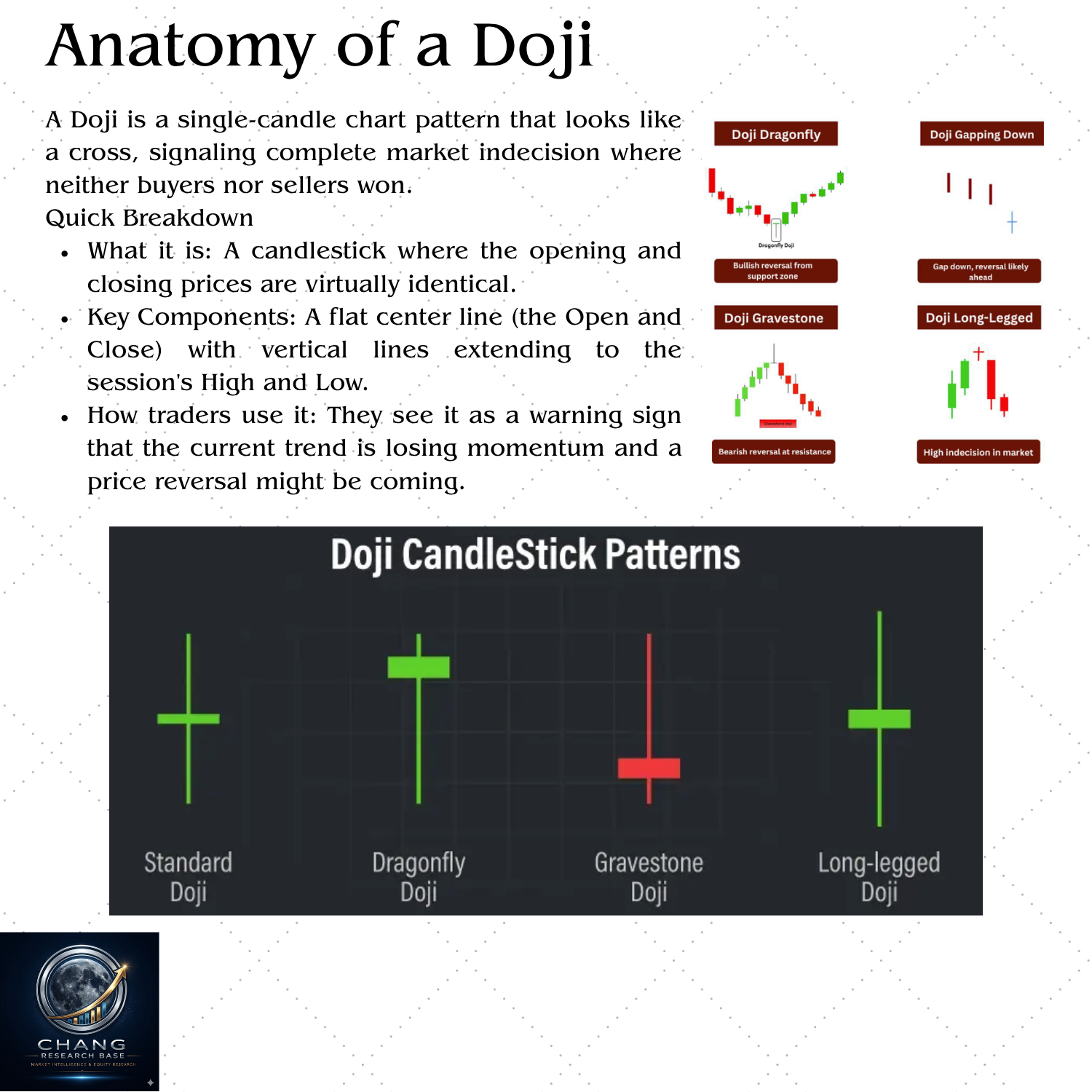
A Doji forms when a session's opening and closing prices are virtually identical, leaving a cross-shaped candle. The wicks can be long or short — what matters is the flat (or near-flat) body.
It forms because buyers and sellers fought to a complete standstill. Buyers pushed prices up during the session. Sellers pushed them back down. Neither side could claim victory. When the dust settled, the price was almost exactly where it started.
This is the market saying: "We are at a crossroads. We don't know which way to go." The Doji doesn't predict the direction — it predicts that a direction is coming.
Imagine two equally-matched armies charging at each other. Both fight fiercely. But at the end of the day, the battle line hasn't moved. That frozen battle line is the Doji body — exhaustion on both sides, with a major breakthrough expected soon.
Never trade the Doji alone. It's a warning, not a signal. After a Doji, wait for the very next candle. If it breaks above the Doji's high → potential buy. If it breaks below the Doji's low → potential sell. Volume should confirm the breakout direction.
Most powerful when it appears after a long trending move (up or down). A Doji after 5+ bullish candles suggests buyers are exhausted. A Doji after a long decline suggests sellers are running out of steam. At key support/resistance levels, the Doji becomes significantly more reliable.
"Sellers tried to destroy this stock. Buyers said no — and fought all the way back."
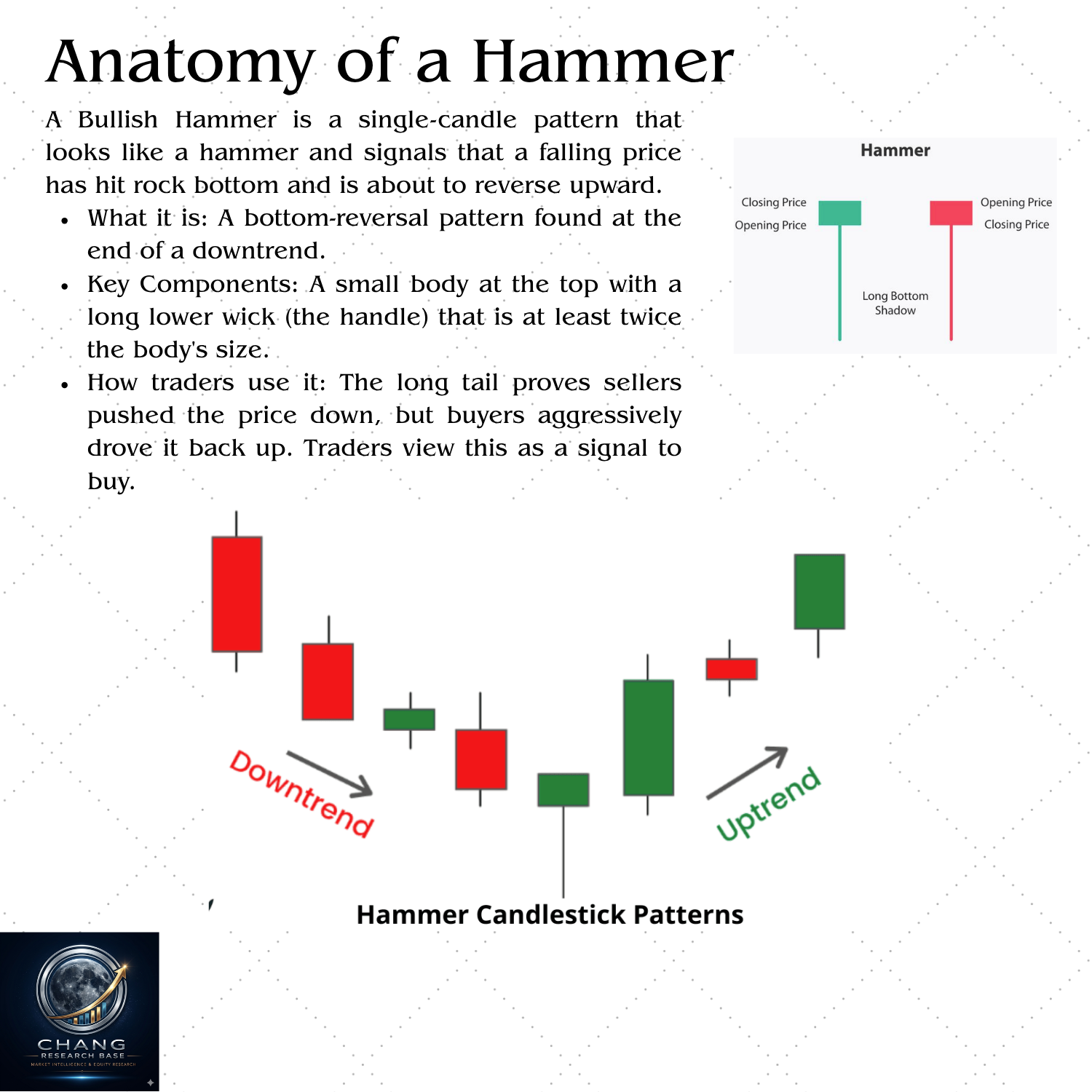
The Hammer is one of the most recognizable and trusted patterns in all of technical analysis. It forms at the bottom of a downtrend and looks exactly like a hammer — small head at the top, long handle below.
Here's what happened during this session: The session opened, and sellers immediately took control. They drove the price way down — sometimes 2×, 3×, or more below the opening price. It looked like another catastrophic day.
Then something changed. Buyers stepped in aggressively. They pushed back against the selling — hard. They fought all the way back up, recovering almost all of the ground the sellers had taken. By the close, the price was back near the open.
The long lower wick is the visual proof of that buyer comeback. The bigger the wick relative to the body, the more powerful the signal.
Entry: Buy when the next candle closes above the Hammer's high — this confirms buyers have taken control.
Stop-Loss: Just below the Hammer's low (the tip of the bottom wick).
Confirmation booster: High volume on the Hammer day + bullish next candle = very strong setup.
A green Hammer means buyers not only fought back — they actually finished the day ahead of where they started (close > open). That's extra confirmation of bullish conviction.
A red Hammer still means buyers fought back strongly (the long wick proves this), but they couldn't quite recover to the open. It's still a valid signal, just slightly weaker. Always look for additional confirmation.
"Buyers made a powerful push upward. They couldn't hold it — but they're waking up. A reversal is brewing."
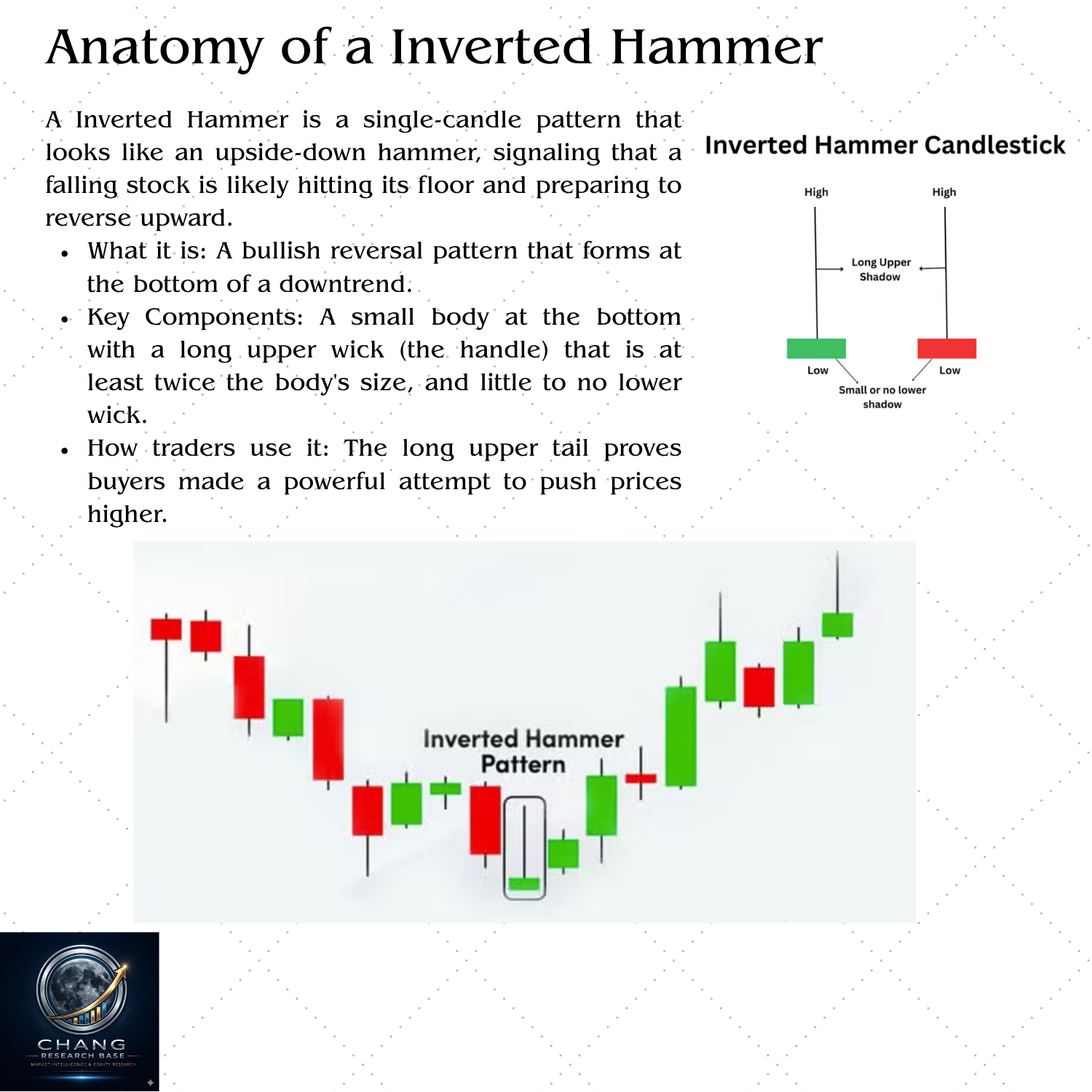
The Inverted Hammer is an upside-down hammer that appears at the bottom of a downtrend. It looks alarming at first — there's a big wick shooting upward from a tiny body at the bottom. That seems bearish, right? Wrong.
Here's the psychology: The market opened low (after a downtrend). Buyers then pushed aggressively upward — driving the price significantly higher during the session (that's the long upper wick). But sellers came back and pushed it back down by the close.
The key insight: For the first time in the downtrend, buyers showed real strength. They didn't win the session — but they put up a serious fight that they hadn't shown before. This is a warning to sellers: the bears may be losing their grip.
Because buyers couldn't fully hold the recovery, this pattern requires stronger confirmation than a regular Hammer before trading it.
Critical context rule: The exact same candle shape appearing at the top of an uptrend is called a Shooting Star — and it's bearish. The candle is identical; only the location changes its meaning entirely.
This pattern needs confirmation more than almost any other. Only enter long if the next candle is a clear bullish (green) candle that closes above the Inverted Hammer's high. Stop-loss below the pattern's low.
Same candle shape. What changes everything is location.
• Inverted Hammer = bottom of downtrend → buyers waking up → bullish
• Shooting Star = top of uptrend → buyers rejected → bearish
This is why candlestick analysis always begins with asking: "Where in the trend am I looking?"
"The rally looks healthy — but sellers just tried to destroy it from within. The asset is losing support."
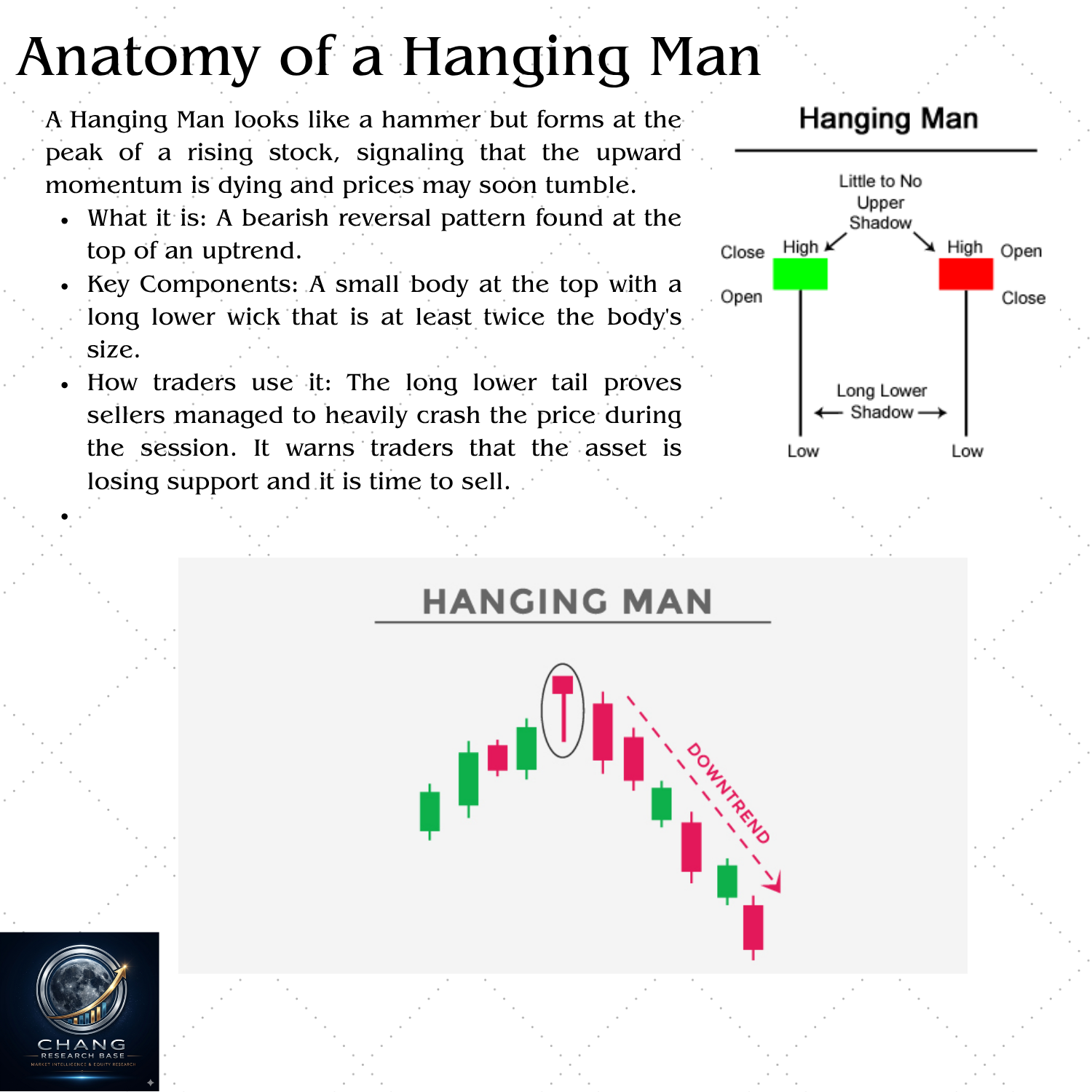
The Hanging Man is visually identical to a Hammer — small body at the top, long lower wick. But it appears at the top of an uptrend, and that changes everything.
During this session, the stock was in a healthy uptrend. The session opened, and then something unexpected happened: sellers violently crashed the price deep below the open. The long lower wick shows how far down sellers drove prices.
Yes, buyers recovered by the close. But the key psychological message is: sellers are now powerful enough to crash this stock significantly during the session. That's new. That didn't happen during the uptrend. It means the support that drove prices higher is starting to crack.
The name is grim for a reason — the long wick "hangs" below the body like legs dangling, suggesting the stock's uptrend may soon be "hanging" in trouble.
Don't sell immediately. Wait for the next candle to close below the Hanging Man's close. That confirmation is your sell/short entry signal. Stop-loss above the Hanging Man's high (top of body or top wick).
The Hanging Man alone is a warning, not a sell signal. The actual sell signal is the next bearish candle. If the next session instead closes higher than the Hanging Man's high — the pattern is nullified and the uptrend continues. Never jump the gun.
"Buyers blasted off like a rocket — then sellers dragged them all the way back to Earth. The rally is over."
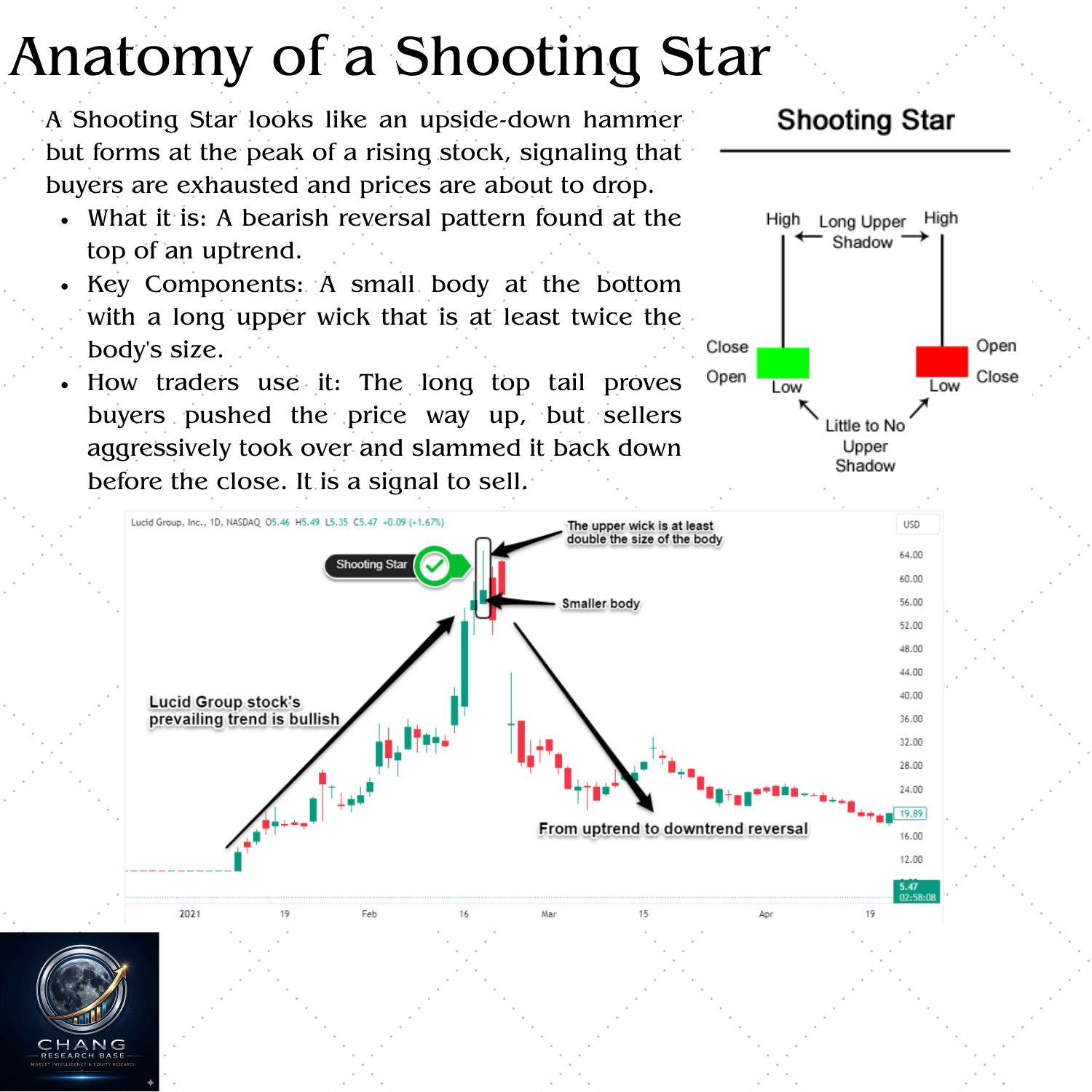
The Shooting Star is one of the most powerful single-candle bearish signals. It appears at the top of an uptrend and tells a devastating story for bulls.
The session begins and buyers are in full control. They push prices aggressively higher — sometimes dramatically so. The stock is rocketing. It looks like another great bullish session.
Then something breaks. Sellers flood the market. They overwhelm the buyers completely and drive prices all the way back down — erasing nearly all of the day's gains. By the close, the price is near the session's opening level (or even lower).
That massive upper wick is the proof: buyers tried their hardest and were completely rejected at higher prices. This is a sign that the market has found a ceiling — a resistance level — that it cannot break through. The bears are in control now.
Entry: Sell/short when the next session's candle closes below the Shooting Star's low.
Stop-Loss: Above the top of the Shooting Star's upper wick.
Power confirmation: High volume on the Shooting Star + bearish gap or confirmation candle = very high conviction sell.
"Both sides fought hard and achieved nothing. The market is at a crossroads — the current trend is running on fumes."
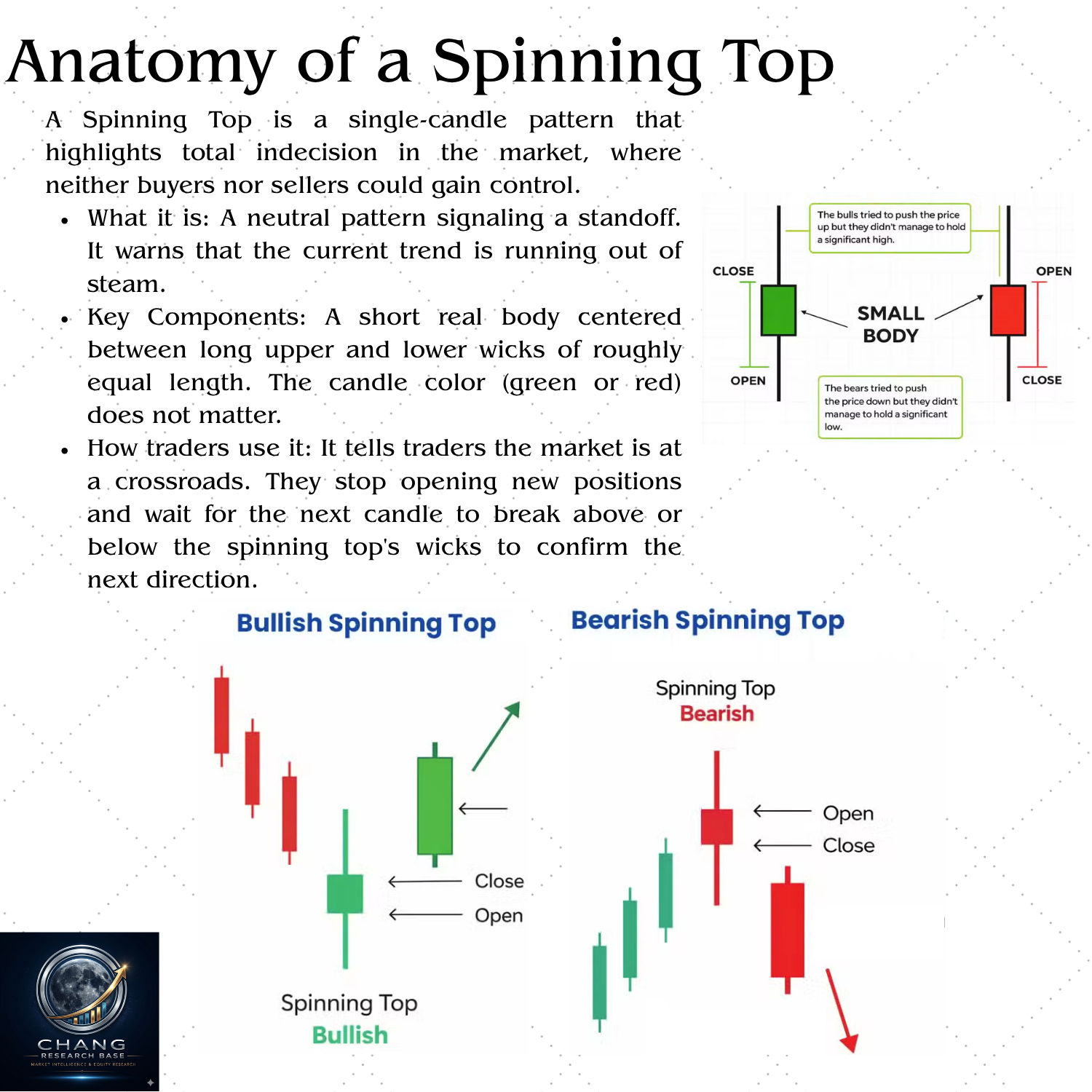
A Spinning Top is similar to a Doji but has a visible small body rather than a flat cross. The body exists — meaning one side did edge out a small win — but it's tiny relative to the wicks.
The key characteristics: roughly equal upper and lower wicks that are substantially longer than the body, and a small real body that can be either green or red. The color barely matters here because the body is so small that the directional difference is insignificant.
The session saw buyers push prices up (upper wick) and sellers push prices down (lower wick) — and both sides retreated to near where they started. It's a tug-of-war that went nowhere.
Unlike the Doji which signals complete indecision, the Spinning Top suggests the current trend is losing momentum — one side is beginning to tire, but we don't yet know which direction the market will break.
The Spinning Top itself is not an entry signal — it's a pause signal. Stop adding to positions in the current trend direction. Wait for the next candle:
• If it breaks above the Spinning Top's high → trend likely continues upward.
• If it breaks below the Spinning Top's low → potential reversal downward.
"One side owned every single tick of this session. No hesitation. No pullback. Pure, uncontested dominance."
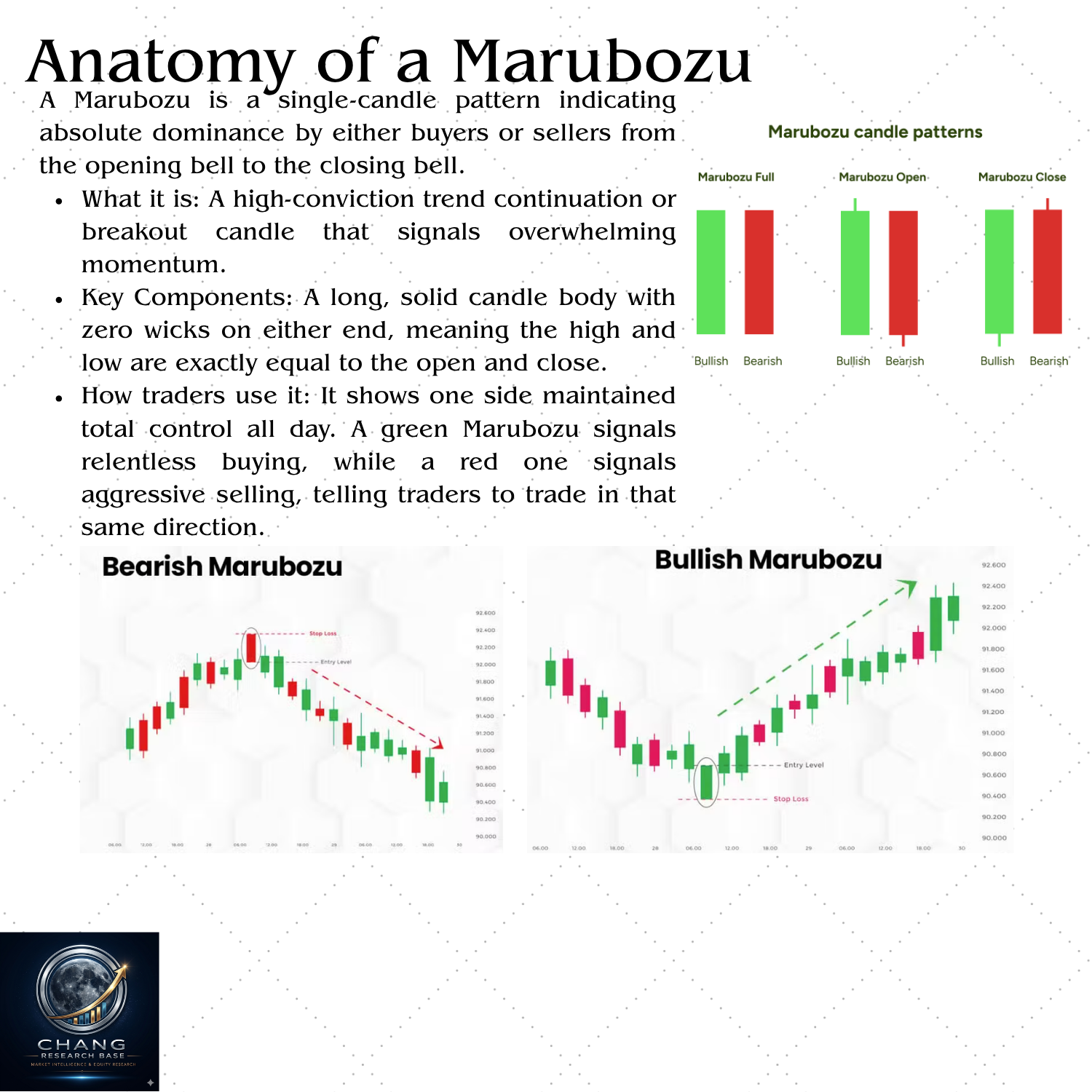
The Marubozu is the purest expression of momentum in candlestick analysis. Its defining feature is simple: no wicks on either end.
This means the session opened at the absolute low (bull) or absolute high (bear) — and moved in one direction without ever looking back. There was no intraday pullback significant enough to leave a wick. The winning side had total control from the opening bell to the closing bell.
A Bullish (Green) Marubozu: Open = Low, Close = High. Buyers took control from the very first trade and never once let sellers make a move. The price climbed relentlessly all session.
A Bearish (Red) Marubozu: Open = High, Close = Low. Sellers took over immediately and crushed the price all session without giving buyers a moment's relief.
This isn't just a reversal signal — it's often a trend continuation signal. When you see a Marubozu after a breakout, it tells you the move is real and has strong conviction behind it.
Breakout confirmation: A Bullish Marubozu after breaking a key resistance level confirms the breakout is real. Enter long on the next session's open or a slight pullback. Stop below the Marubozu's low.
Breakdown confirmation: A Bearish Marubozu after breaking a key support confirms the breakdown. Enter short. Stop above the Marubozu's high.
Earnings announcements frequently produce Marubozu candles — especially after big beats or misses. A large-bodied, wick-free candle on earnings day is one of the clearest signals that institutional money has decisively repositioned, making continuation very likely over the next few sessions.
"The price tried to break out in one direction, got caught in a lie, and snapped violently back the other way. A powerful rejection."
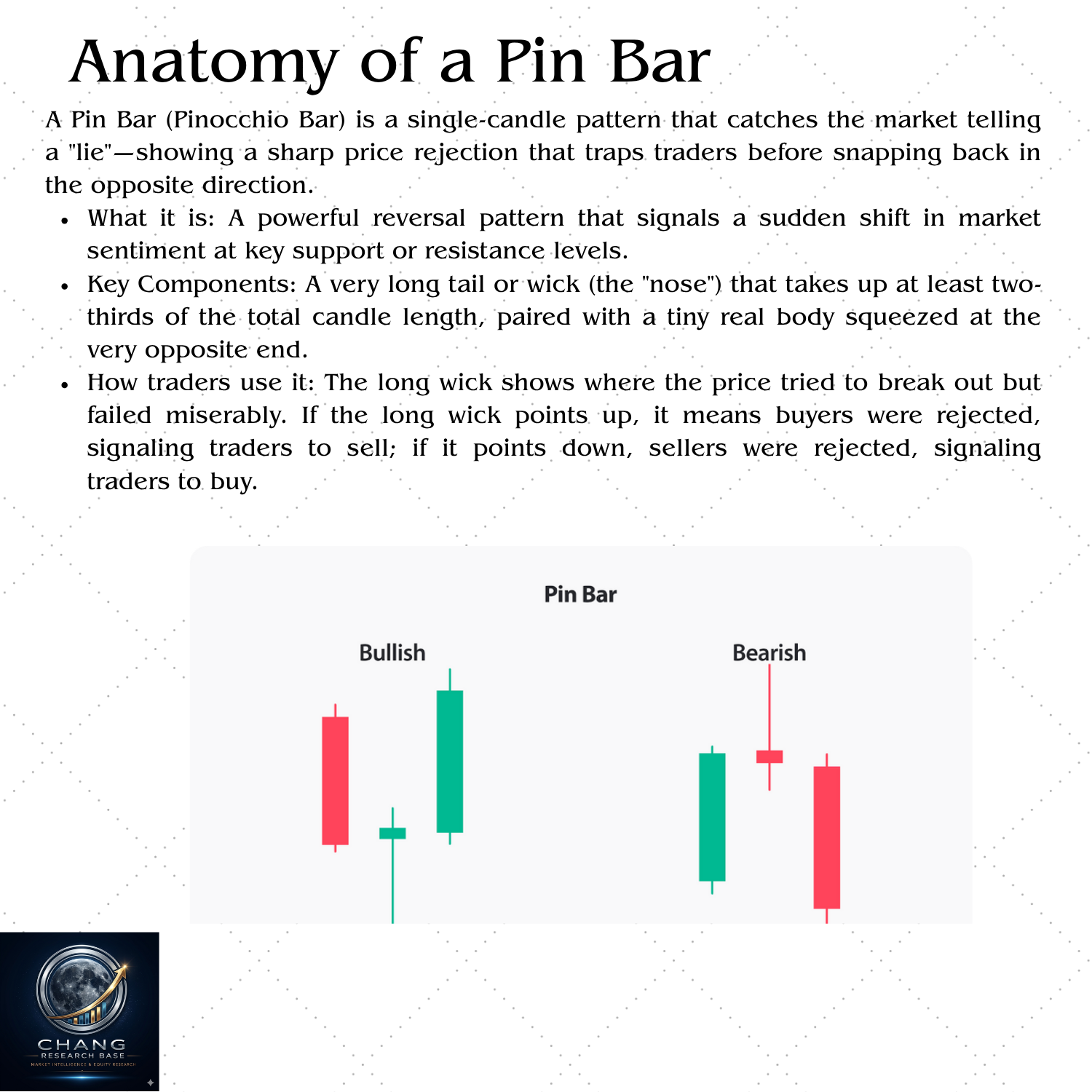
The Pin Bar gets its nickname because the market "lies." The long wick — called the "nose" (like Pinocchio's) — shoots out in one direction, trapping traders who follow the fake move. Then the market snaps back violently the other way, trapping and punishing those who followed the false breakout.
Bullish Pin Bar: The nose points downward. Sellers drove price down aggressively, triggering stop-losses below support. Then buyers overwhelmed them completely, driving the price back up. All those sellers got trapped. Buyers now have control.
Bearish Pin Bar: The nose points upward. Buyers drove price up aggressively, triggering buy orders above resistance. Then sellers overwhelmed them, driving the price back down. All those buyers got trapped.
The Pin Bar is especially powerful because it catches trapped traders on the wrong side — their forced exits (stop-loss triggers) fuel the reversal even further.
Entry: Buy on the open of the next candle, or on a 50% retracement of the Pin Bar body (conservative). Stop-loss just below the bottom of the nose. Target: nearest resistance or 2:1 risk/reward.
Many Pin Bars form because large institutional players deliberately push price to known stop-loss clusters (just below support or above resistance) to trigger them, accumulate inventory at better prices, then reverse. The Pin Bar's nose is literally the footprint of this "stop hunt." Recognizing this gives you a powerful edge in understanding why they work so consistently.
2-Candle Patterns
Two candles build a richer story — the first sets up the situation, and the second delivers the verdict. Together, they carry more conviction than any single candle alone.
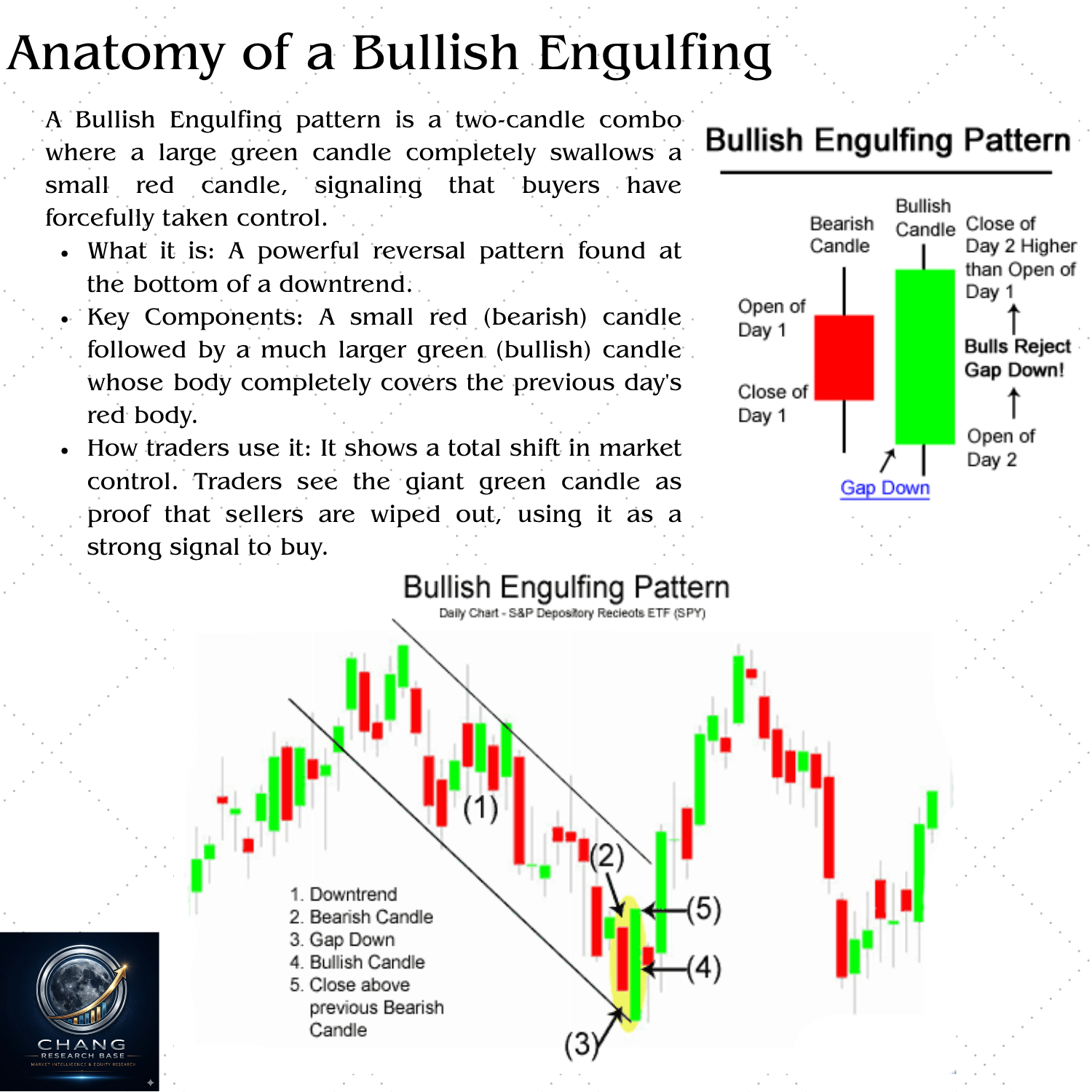
"Buyers didn't just win — they completely obliterated the sellers and kept going. A total shift in power."
Day 1: A bearish (red) candle — sellers are in control and the downtrend continues as expected.
Day 2: Something dramatic happens. The session opens lower than the previous close — gapping down, which initially seems even more bearish. But then buyers immediately launch a powerful counterattack. They drive the price higher all session — not just recovering the previous day's losses, but surging well past the previous day's open.
The result: a large green candle whose body completely covers (engulfs) the previous red candle's body. The bulls have done two things: reversed the prior day's move AND added new gains on top. This is a total shift in market control.
The pattern is even more powerful when the green candle engulfs not just the body but also the wicks of the prior red candle — showing complete dominance.
Entry: Buy on the open of Day 3, or as Day 2 closes above Day 1's open (aggressive entry).
Stop-Loss: Below the low of the Bullish Engulfing pattern (Day 2's low).
Best conditions: At major support + high volume + the green candle is significantly larger than the red.
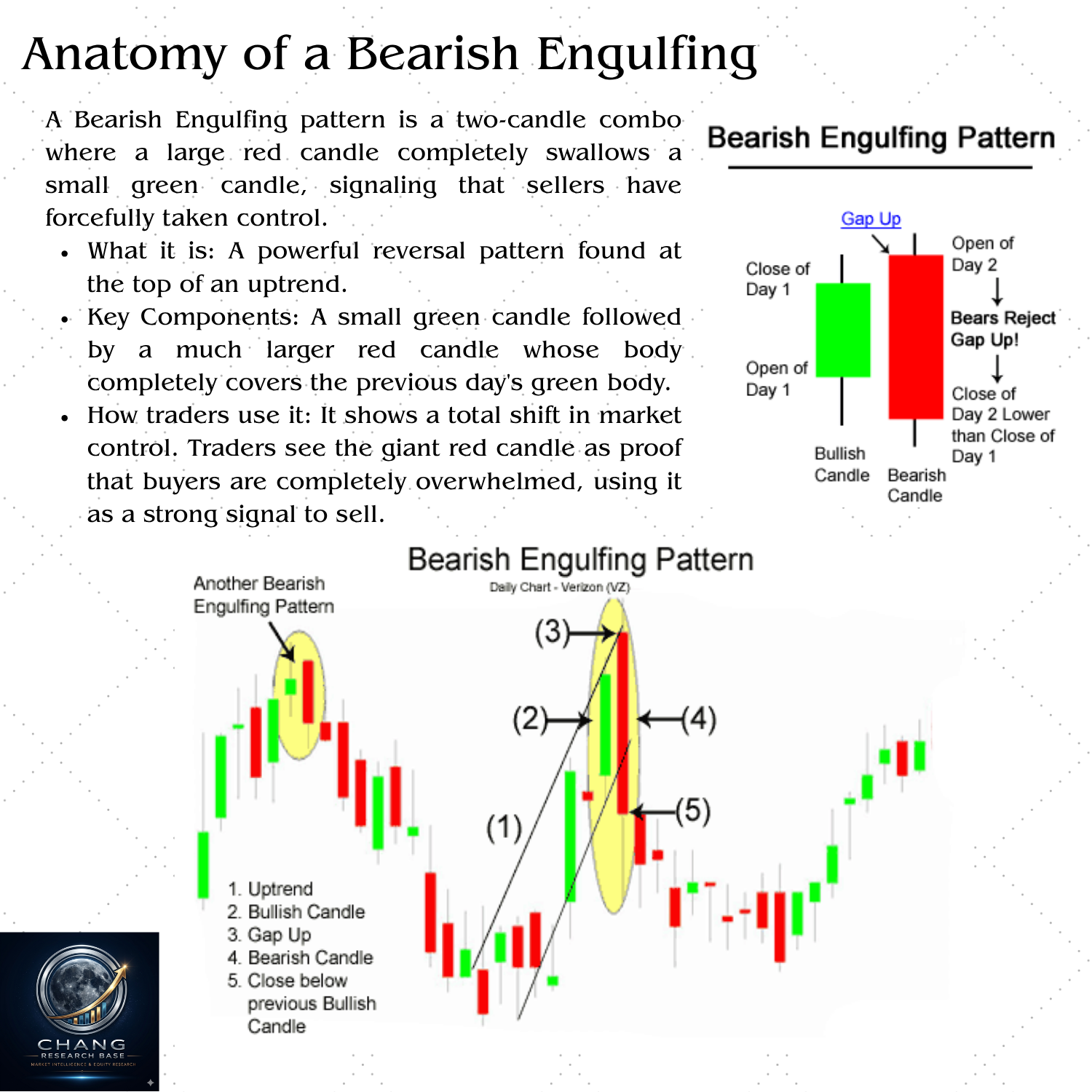
"Sellers swept in and completely overwhelmed the buyers — erasing all of their gains and going further. The bulls have been routed."
Day 1: A bullish (green) candle — buyers are in control and the uptrend seems to continue.
Day 2: The session gaps up (seeming to promise more upside), but sellers immediately hammer the price. They don't just reverse the previous day's gains — they crash through the previous day's open entirely, closing below it with a large red candle that completely engulfs the prior green body.
This is a total market reversal. The same buyers who were celebrating yesterday are now trapped, watching their profits evaporate. Those trapped longs become fuel for the selling pressure as they exit with stop-losses.
The bigger the red candle relative to the green one, the more powerful the signal.
Entry: Sell/short on the open of Day 3, or as Day 2's close moves below Day 1's open.
Stop-Loss: Above the high of the pattern (Day 2's high).
Best conditions: At major resistance + high volume + after a prolonged uptrend.
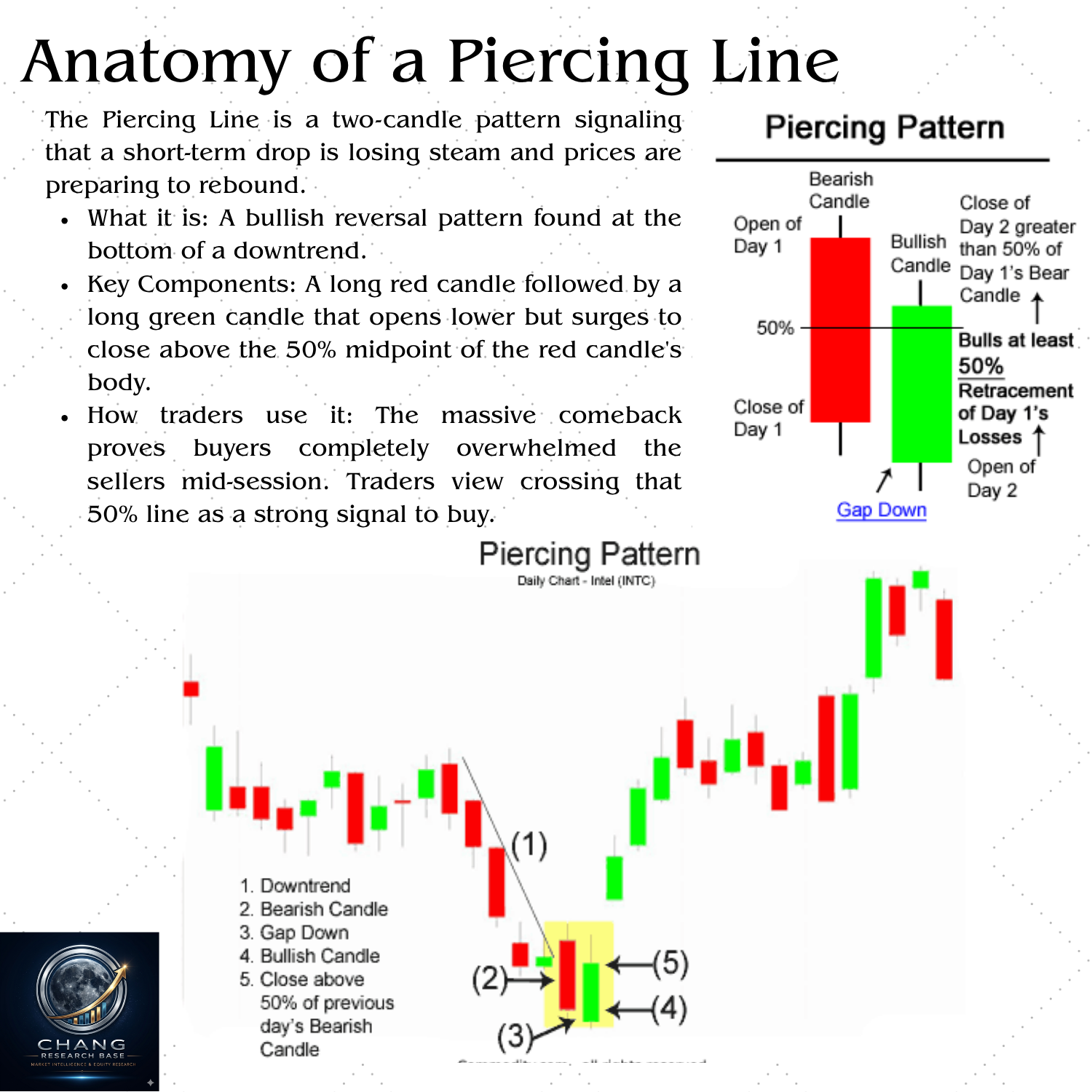
"The selloff looked overwhelming. Then buyers pierced through the halfway mark — showing they have the power to recover."
Day 1: A long bearish (red) candle. Sellers are winning convincingly.
Day 2: The session gaps down below Day 1's close — which initially looks even more bearish. But buyers immediately mount a comeback. They drive the price steadily upward all session long, ultimately closing above the 50% midpoint of Day 1's red candle.
The 50% threshold is critical. Crossing it means buyers have recovered more than half of the previous day's selling losses in a single session. That's a dramatic demonstration of bullish buying power.
Think of it like a sports comeback: if your team was down 6-0 and fights back to lead 4-3 by halftime, you'd feel very differently about the second half. The buyers just made that kind of comeback.
The Piercing Line is similar to a Bullish Engulfing but doesn't complete the full reversal. In an Engulfing, Day 2 closes above Day 1's open — a full reversal. In a Piercing Line, Day 2 closes above Day 1's midpoint but below Day 1's open. It's a bullish reversal signal, but slightly weaker and requires more careful confirmation.
Enter long after Day 2 confirms (on Day 3's open). Stop below Day 2's low. The closer the close is to Day 1's open (the higher the pierce), the stronger the signal.
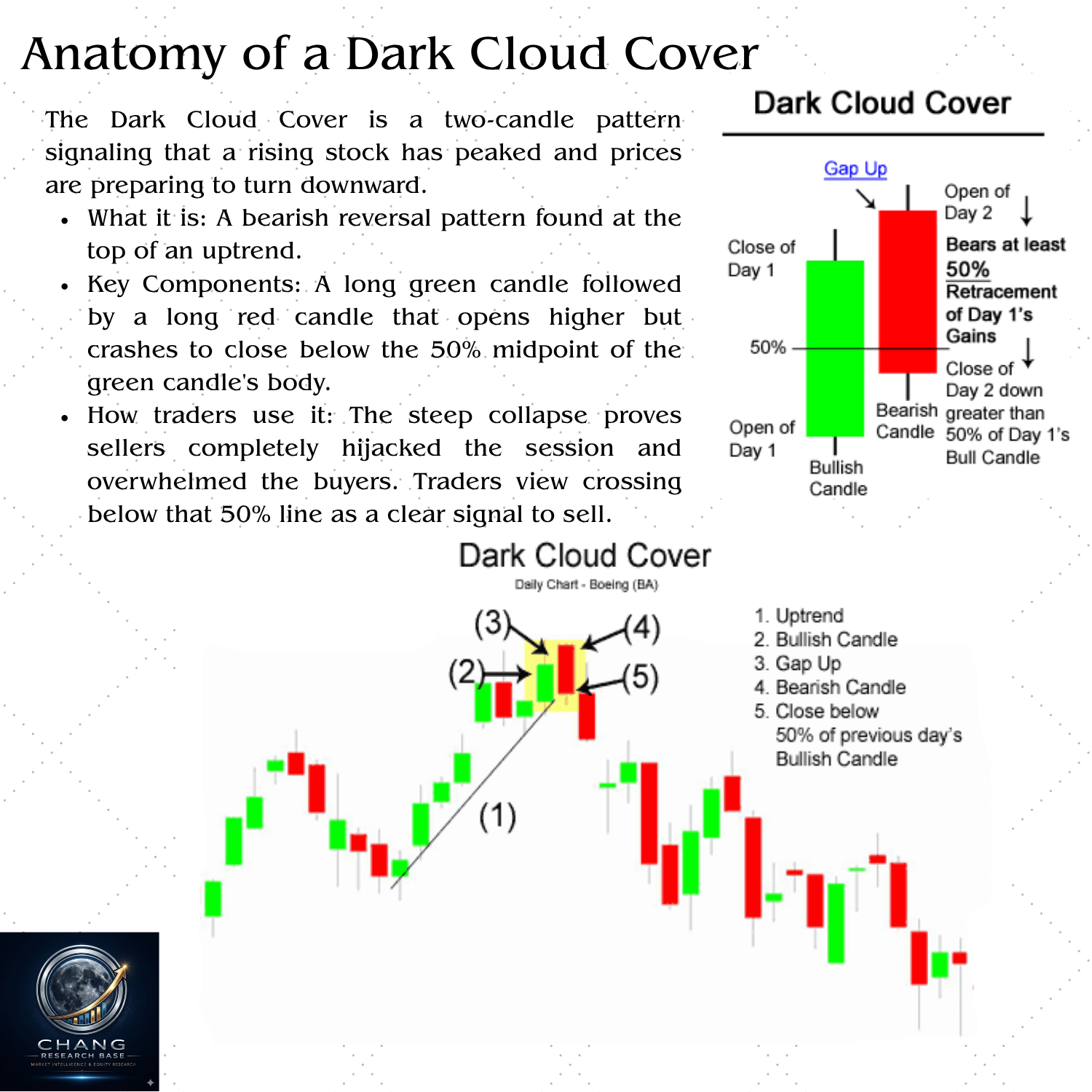
"The rally looked bright — then a dark cloud rolled in and wiped out more than half the gains. The bull run is clouding over."
Day 1: A strong bullish (green) candle. The uptrend is healthy.
Day 2: The session gaps up above Day 1's close — optimism is high. But sellers immediately take control and drive the price down relentlessly. By the close, the price has crashed below the 50% midpoint of Day 1's green candle.
That 50% penetration is the critical signal. Sellers have erased more than half of the previous session's bullish gains — in a single session. This is a significant demonstration of selling power that the bulls did not expect.
The pattern is called "Dark Cloud Cover" because, like a storm rolling in on a sunny day, the big red candle casts a shadow over the bullish sentiment that had been building.
Sell/short on Day 3's open, or as Day 2 closes below Day 1's midpoint. Stop-loss above Day 2's high (the gap-up open). If Day 2's red candle closes very close to Day 1's open (near full engulf), treat it as near-Bearish Engulfing strength.
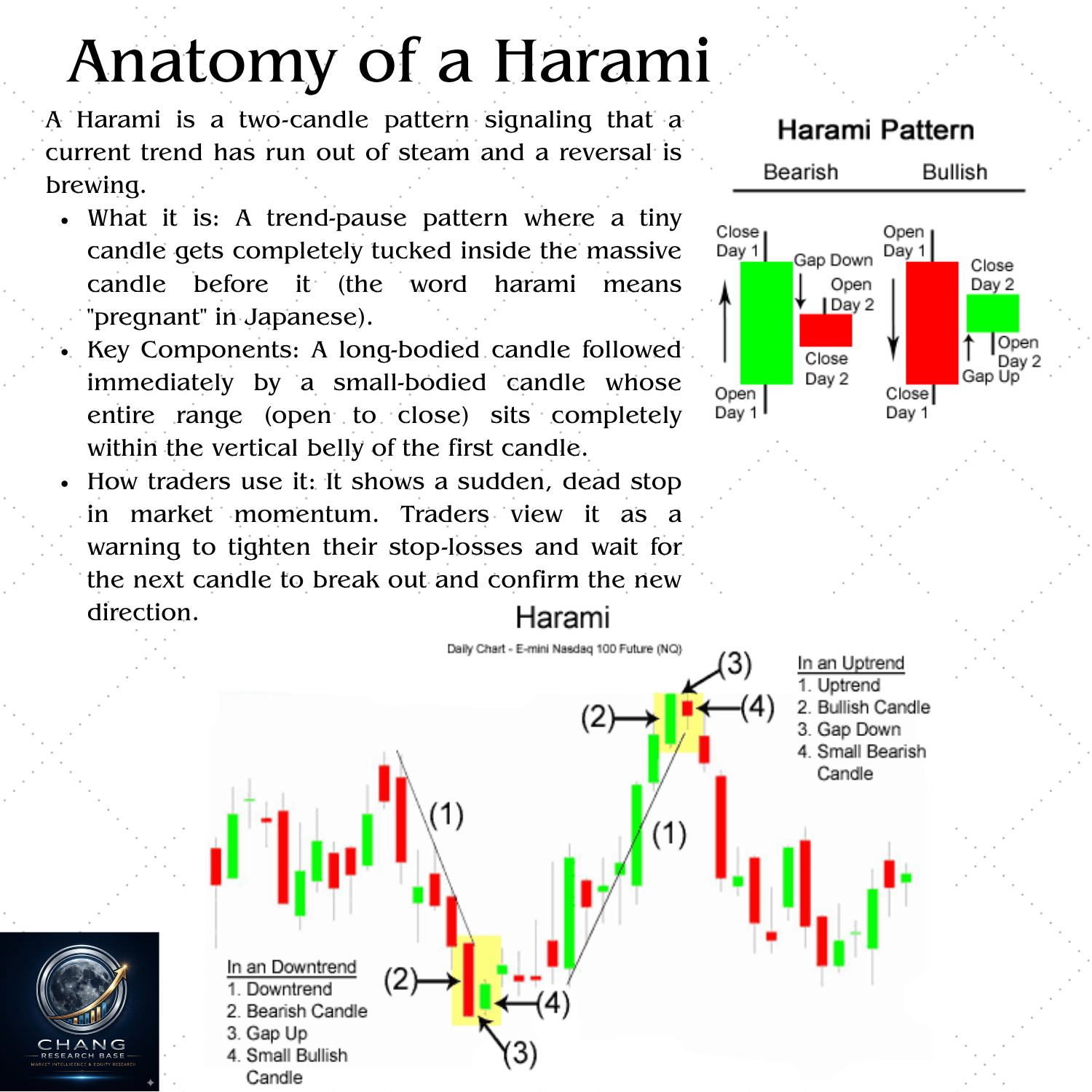
"Momentum has hit a sudden wall. The market has gone quiet — but a direction change is almost certainly brewing."
Day 1: A large, strong candle in the direction of the existing trend. Everything looks normal.
Day 2: A tiny candle appears — its entire body fits within the body of Day 1. Not just smaller — completely contained inside the previous candle, like a baby in a womb.
What happened? The market had a sudden, complete loss of momentum. The session opened within yesterday's range, moved barely at all, and closed still within yesterday's range. The conviction that drove the prior trend has evaporated overnight.
A Bearish Harami has a large green Day 1 candle followed by a small red Day 2 candle tucked inside — after an uptrend. It warns that buyers may be running out of steam.
A Bullish Harami has a large red Day 1 candle followed by a small green Day 2 candle tucked inside — after a downtrend. It warns that sellers may be exhausting themselves.
These look similar but have an important distinction:
The Harami is a warning, not a trigger. On Day 2, tighten stop-losses on existing trend positions. Wait for Day 3 to confirm:
• Bullish Harami: Day 3 closes above Day 2's high → consider buying
• Bearish Harami: Day 3 closes below Day 2's low → consider selling
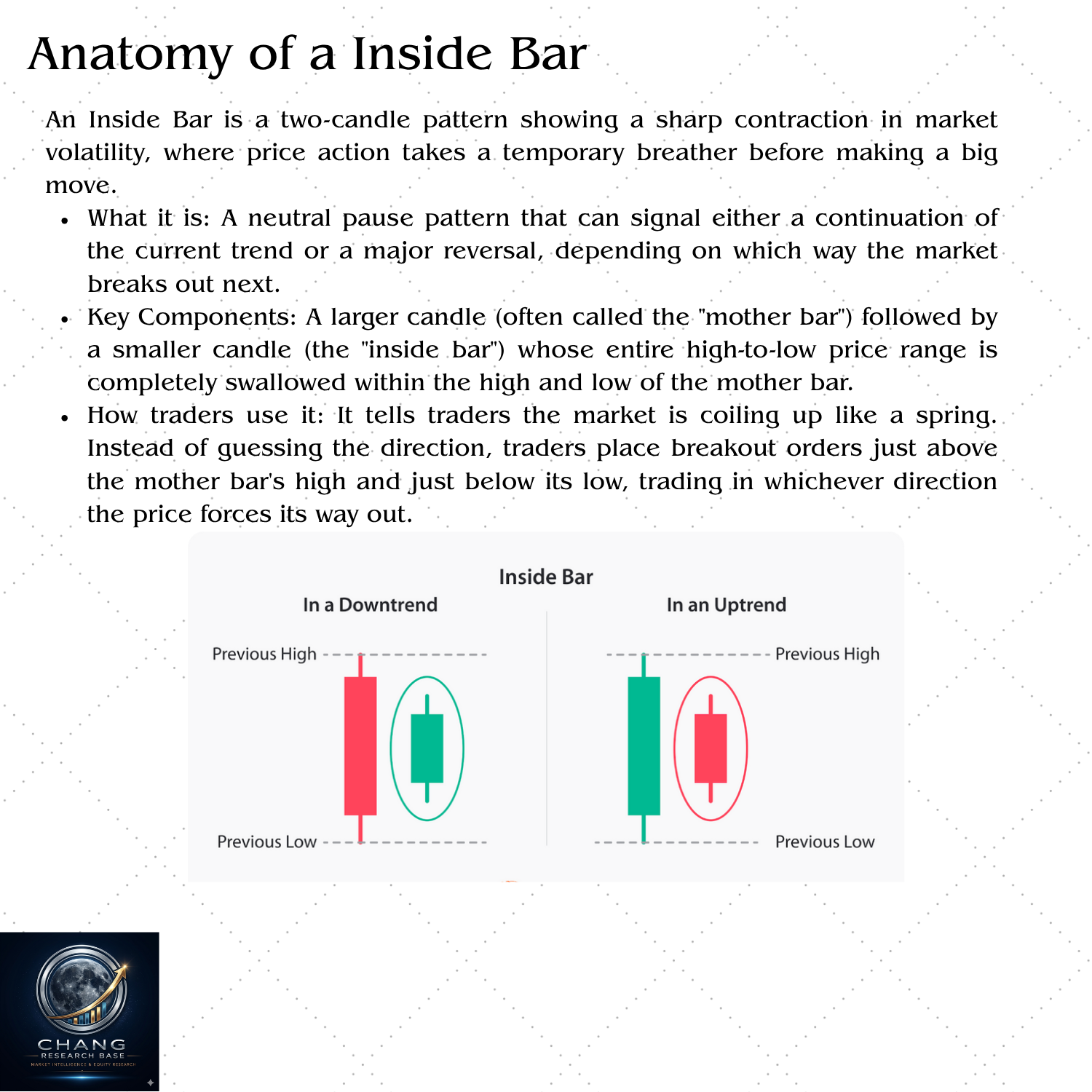
"The market is coiling up like a spring. Volatility has collapsed — a big explosive move in either direction is loading up."
The Inside Bar is a pattern of volatility contraction — a pause in the market's breathing. The "mother bar" is a relatively large candle that represents a normal active session. The "inside bar" that follows is a much smaller candle whose entire range — including wicks — fits within the mother bar's high-to-low range.
What does this mean? The entire session didn't even reach yesterday's high or low. Price action compressed dramatically. Buyers and sellers are in a standoff — neither side could push beyond the previous session's boundaries.
This is like a spring being compressed. The longer the price stays compressed, the more energy builds for the eventual breakout. Traders don't predict direction — they wait for the spring to release.
Inside Bars are especially common just before major market-moving events (earnings, economic data) or after a significant trending move that needs to "digest."
Many traders place two breakout orders simultaneously:
• A buy-stop just above the mother bar's high
• A sell-stop just below the mother bar's low
Whichever triggers first is the trade. Cancel the other immediately. Stop-loss on the triggered order goes just on the other side of the mother bar.
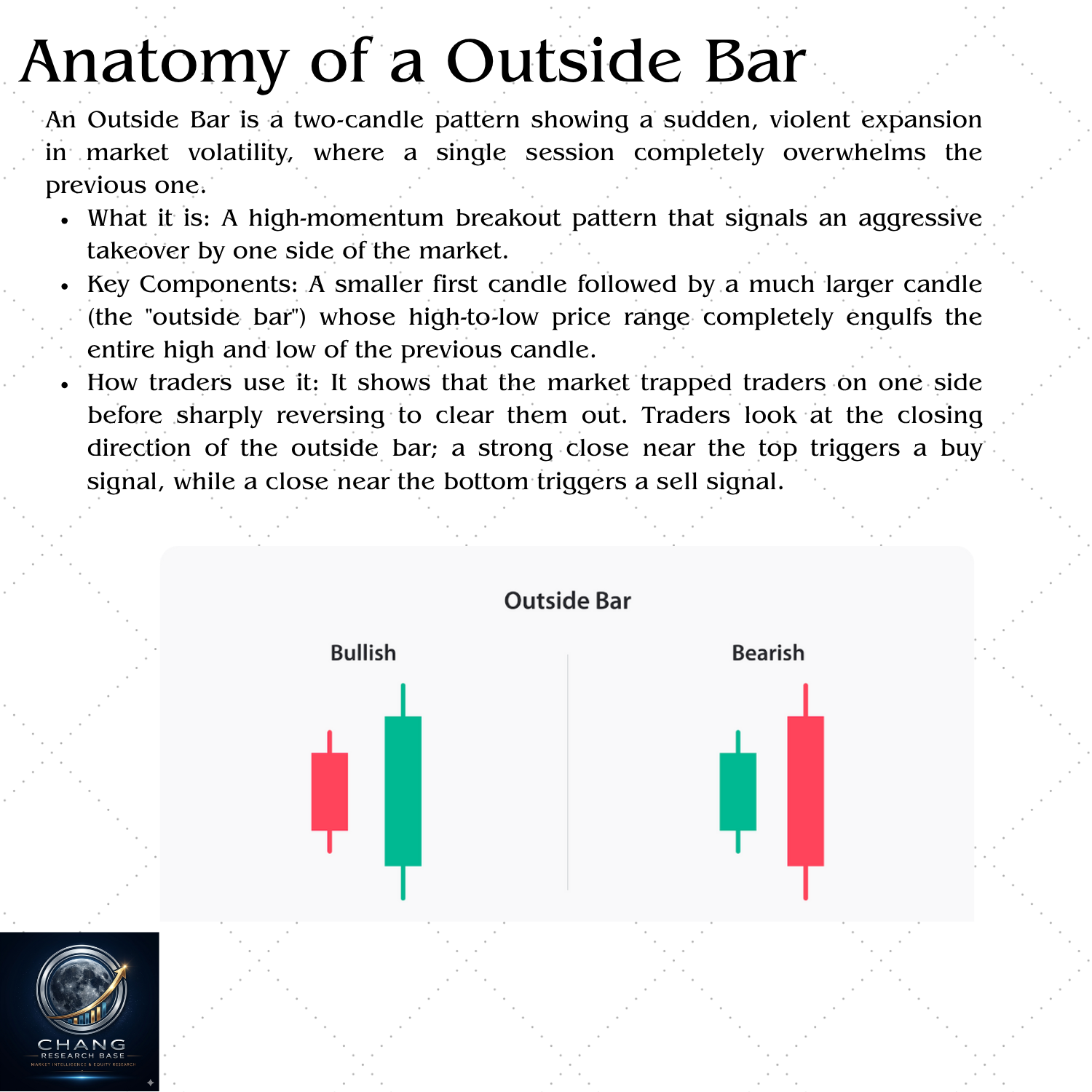
"One side completely overwhelmed the other — the price didn't just test new territory, it exploded through and kept going."
Where an Inside Bar shows volatility contracting, an Outside Bar shows volatility exploding violently. The second candle's range completely engulfs the first — trading above yesterday's high AND below yesterday's low, before closing decisively in one direction.
This tells a story of a market that trapped traders on one side, then violently reversed to trap them. The second candle tests both the high (trapping sellers with short stops) and the low (trapping buyers with long stops) before accelerating in the ultimate closing direction.
The closing direction is everything. An Outside Bar that closes in the upper 25% of its range is strongly bullish. One that closes in the lower 25% is strongly bearish. A close in the middle (near the prior session's range) signals continued confusion.
Bullish: Enter long as the Outside Bar closes strongly. Stop below the Outside Bar's low.
Bearish: Enter short as the Outside Bar closes weakly. Stop above the Outside Bar's high.
Rule: Only trade Outside Bars with a decisive directional close. Skip ambiguous middle closes entirely.
3-Candle Patterns
Three sessions. Three chapters of a complete story — setup, pause, and confirmation. These are the most highly trusted reversal patterns in technical analysis.
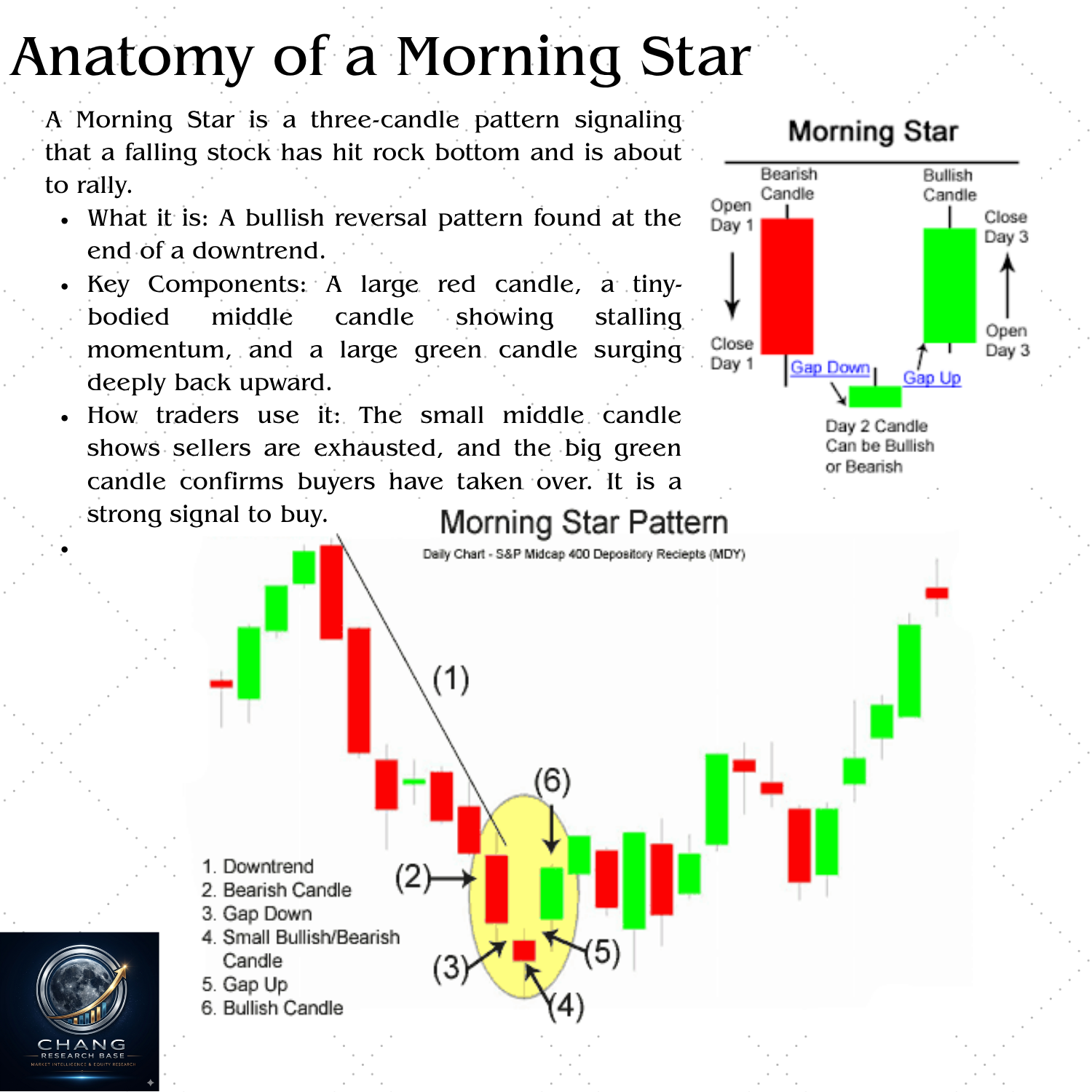
"Darkness, hesitation, then dawn. The stock has bottomed out. The new day is beginning."
The Morning Star is one of the most powerful and reliable reversal patterns in candlestick analysis. Each of its three candles plays a distinct, essential role:
Act 1 — The Bearish Day: A large red candle. Sellers are firmly in control. The downtrend continues as expected. Bears feel confident.
Act 2 — The Star: A tiny candle (often a Doji or near-Doji) that gaps down below the first candle's close. This is the moment the downtrend pauses. Sellers tried to push lower but barely moved the price. Selling momentum has stalled. The "star" is suspended below the prior candle, representing the uncertainty and exhaustion at the bottom.
Act 3 — The Bullish Confirmation: A large green candle that surges powerfully upward, closing deeply into the body of Day 1's red candle — ideally above its midpoint. Buyers have definitively taken control. The reversal is confirmed. The "morning" has arrived after the darkness.
Together, these three candles tell a complete, confirmed story: sellers exhausted, buyers energized, trend reversed.
Entry: Buy on Day 3's close, or on Day 4's open after confirmation.
Stop-Loss: Below the low of Day 2 (the star's low — the bottom of the pattern).
Target: Previous resistance level or Fibonacci retracement. Minimum 2:1 risk/reward.
When Day 2 is specifically a Doji (rather than any small candle), the pattern is called a Morning Doji Star — and it's even more reliable. The Doji on Day 2 makes the indecision/exhaustion point even clearer, adding another layer of confirmation to the eventual bullish reversal.
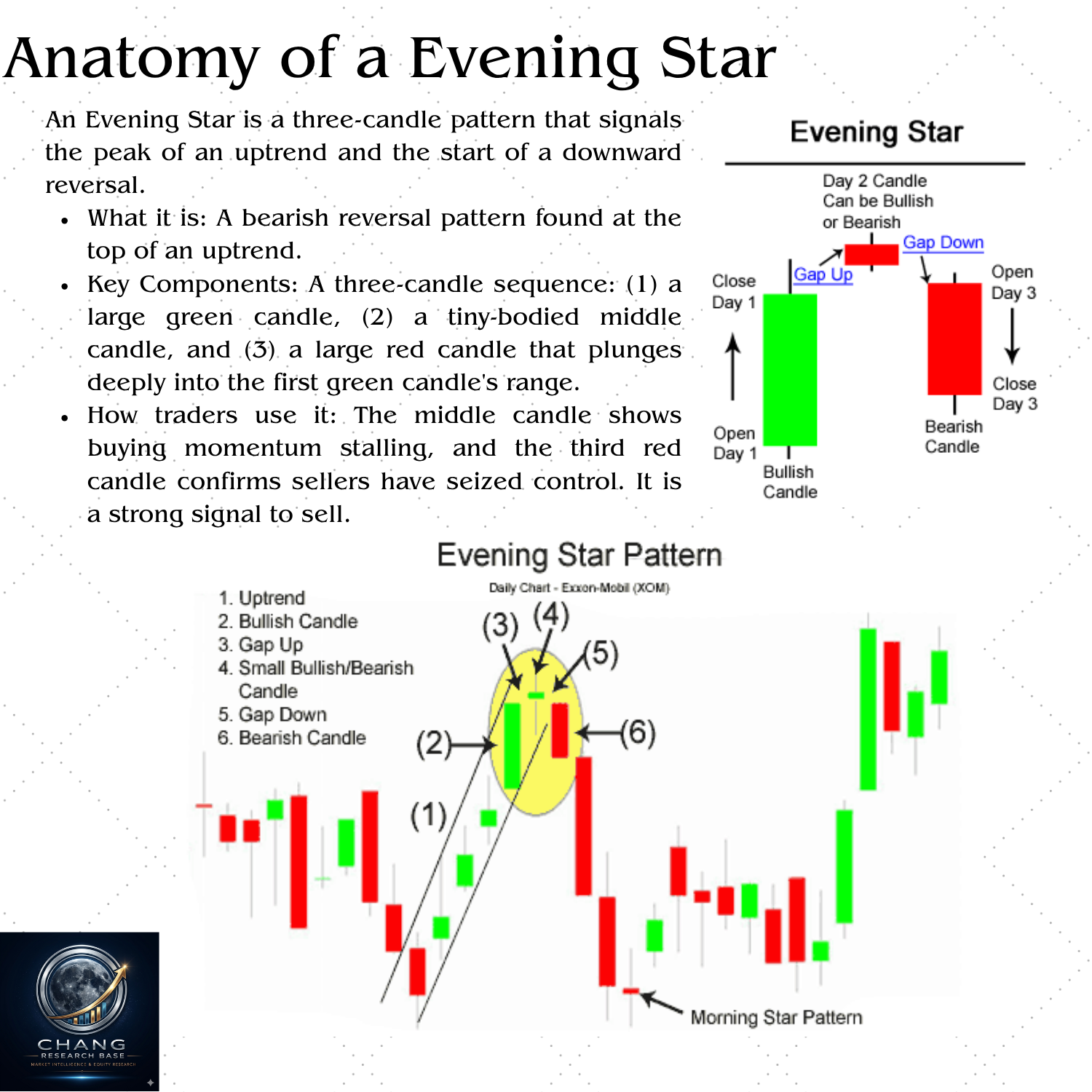
"The rally reaches its peak under a bright evening star — then the night falls. The bull run is over."
The Evening Star is the bearish mirror image of the Morning Star — equally powerful, equally reliable, equally important to know.
Act 1 — The Bullish Day: A large green candle. Buyers are in full control. The uptrend continues strongly. Bulls feel confident and may be adding to positions.
Act 2 — The Star: A tiny candle that gaps up above Day 1's close. Initially this looks bullish — but the tiny body shows that buying momentum has completely stalled. Buyers tried to push higher but the market barely moved. The "star" sits above the prior candle, shining brightly — but it's an evening star, signaling the approaching darkness.
Act 3 — The Bearish Collapse: A large red candle crashes down, closing deeply into Day 1's bullish body. Sellers have completely seized control. The reversal is confirmed.
The pattern is particularly devastating for bulls caught at the top — they bought during Day 1's rally, watched Day 2 do nothing, and then see Day 3 erase all those gains.
Entry: Sell/short as Day 3 closes, or on Day 4's open.
Stop-Loss: Above the high of Day 2 (the star) — the highest point of the pattern.
Target: Prior support levels. Minimum 2:1 risk/reward.
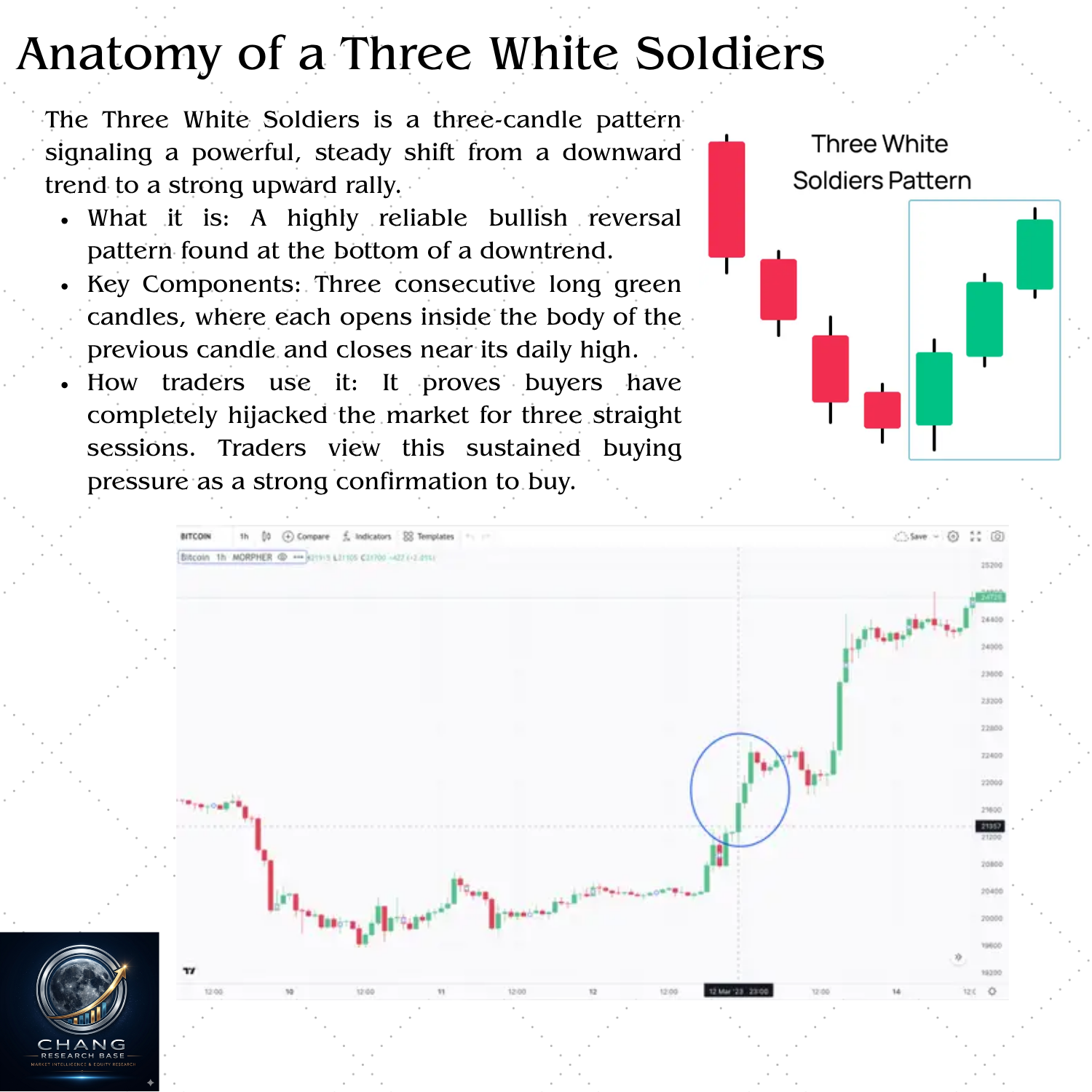
"Not a fluke. Not a one-day wonder. Three consecutive sessions of pure buyer dominance — a new bull trend has begun."
A single bullish candle could be a fluke. Two could be a brief relief rally. But three consecutive sessions of strong buying, each following the same discipline? That is a trend change — confirmed.
The Three White Soldiers pattern features three consecutive large green candles, each following a specific disciplined pattern: each one opens within the body of the previous candle (not gapping up wildly — a controlled advance) and closes near its daily high (showing buyers are still pushing at the end of each session with no exhaustion).
This combination — opening within the prior body and closing near the high — is crucial. It shows steady, disciplined accumulation rather than a panic-driven short squeeze. Institutions are systematically buying over three consecutive sessions, and the market is responding methodically.
The pattern is most powerful when it appears after a significant downtrend or at a key support level, signaling that the selling pressure has been completely overwhelmed by new buying demand.
Buy on Day 4's open (the first session after the pattern completes) or at a slight pullback to Day 3's midpoint. Stop below Day 3's low.
Warning: After three strong sessions, a short-term pullback is common before the rally continues. This is normal — don't panic out of positions.
When three consecutive sessions of strong buying occur in a disciplined pattern, it typically means large institutional investors (funds, banks, pension funds) are systematically accumulating shares over multiple sessions. They can't buy everything at once without moving the price against themselves, so they spread purchases across days. The Three White Soldiers pattern is often their footprint.
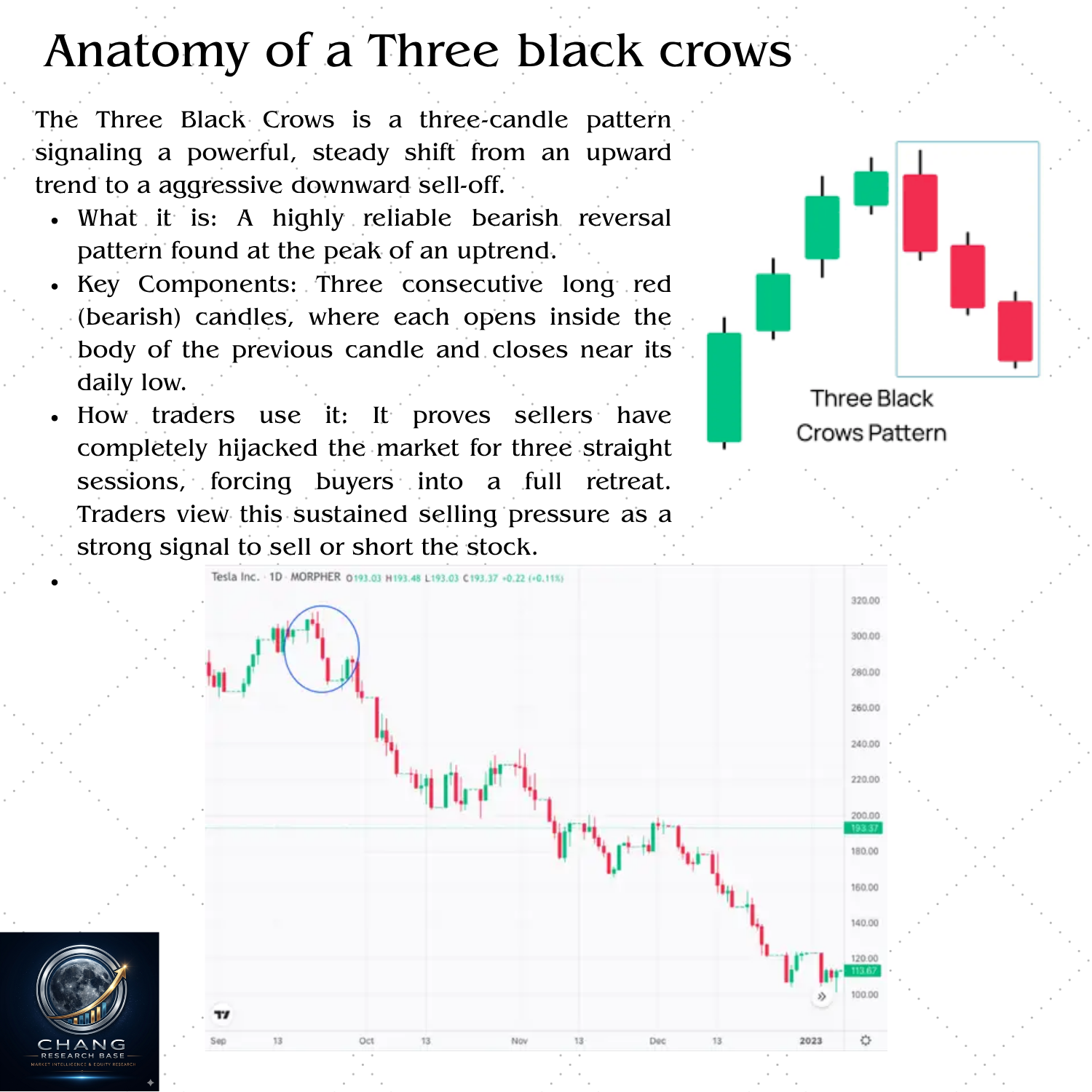
"Three days of relentless, disciplined selling. The buyers have been broken. A new bear trend has arrived."
Three Black Crows is the bearish equivalent of Three White Soldiers — and it is equally feared and respected. Three consecutive long red candles, each following strict rules, signal that sellers have decisively taken control of the market for three straight sessions without buyers mounting any meaningful response.
The pattern earns its ominous name because in many cultures, crows circling overhead are seen as harbingers of death — and for bulls, this pattern is exactly that. Three sessions of systematic, disciplined selling pressure.
Unlike a panic-driven crash (which can reverse quickly), Three Black Crows represents orderly, institutional distribution — large holders are systematically unloading positions over multiple sessions. This kind of selling tends to continue for longer and doesn't reverse easily.
The pattern is most significant when it appears at the top of a prolonged uptrend, at key resistance levels, or after a period of euphoric buying.
Entry: Sell/short on Day 4's open. A slight bounce back into Day 3's body (if it occurs) is an even better entry point.
Stop-Loss: Above Day 3's high (or Day 1's high for a wider stop).
Caution: After three large red candles, a dead-cat bounce (brief up-move) is common before selling resumes. Don't get spooked out of the position by a brief bounce.

Just as Three White Soldiers signals institutional accumulation, Three Black Crows often signals institutional distribution — large holders systematically selling positions over multiple days to avoid crashing the price all at once. When you see this pattern after a prolonged bull market, be very cautious about holding long positions.
Master These First
Pattern recognition is only half the skill. These rules are what separate profitable traders from those who get destroyed.
A Hammer at a bottom is bullish. A Hammer at the top (Hanging Man) is bearish. The exact same candle has completely opposite meanings based on where it appears. Always identify the trend before identifying the pattern.
Candlestick patterns signal potential — not certainty. Always wait for the next candle to close in the expected direction before entering a trade. This one habit alone eliminates the majority of false signals that trap beginners.
A pattern with high volume is dramatically more reliable than the same pattern on thin volume. High volume = institutional participation. Without volume backing a pattern, you're trading a shadow. Always check volume before entering.
A Pin Bar at a major resistance level is a completely different signal from a Pin Bar in the middle of a chart. Support, resistance, Fibonacci levels, moving averages, and trend lines all amplify pattern signals. The best trades have multiple factors aligning at once.
A Bullish Engulfing needs the green candle to be noticeably larger than surrounding candles to matter. Patterns formed by tiny candles in a market full of large candles are unreliable. The size of the pattern relative to recent activity determines its strength.
A Morning Star on a weekly chart is far more powerful than one on a 1-minute chart. Higher timeframes carry more weight. Patterns on daily and weekly charts reflect decisions by large institutional traders. Use multiple timeframes — confirm higher timeframes before acting on lower timeframe signals.
Even the most reliable pattern fails 30-40% of the time. No pattern wins every trade. Your stop-loss placement and position sizing determine whether you survive the losses to benefit from the wins. Always define your maximum loss before entering any trade. The best traders think about risk first and profit second.
⚠️ Important Disclaimer
Candlestick patterns are tools for probabilistic analysis, not guaranteed predictions. Past pattern performance does not guarantee future results. All trading involves substantial risk, including the possible loss of your entire investment. This guide is for educational purposes only and does not constitute financial advice. Always use stop-losses, practice on paper trading accounts, and consider consulting a qualified financial advisor before trading with real capital.
Press Esc or click outside to close